Every dollar your beverage brand spends falls into one of two categories: fixed costs that stay the same regardless of how many cases you produce, and variable costs that scale directly with volume. Knowing which is which — and how they interact — is the foundation of sound pricing, accurate margin forecasting, and smart growth planning.
Free Download
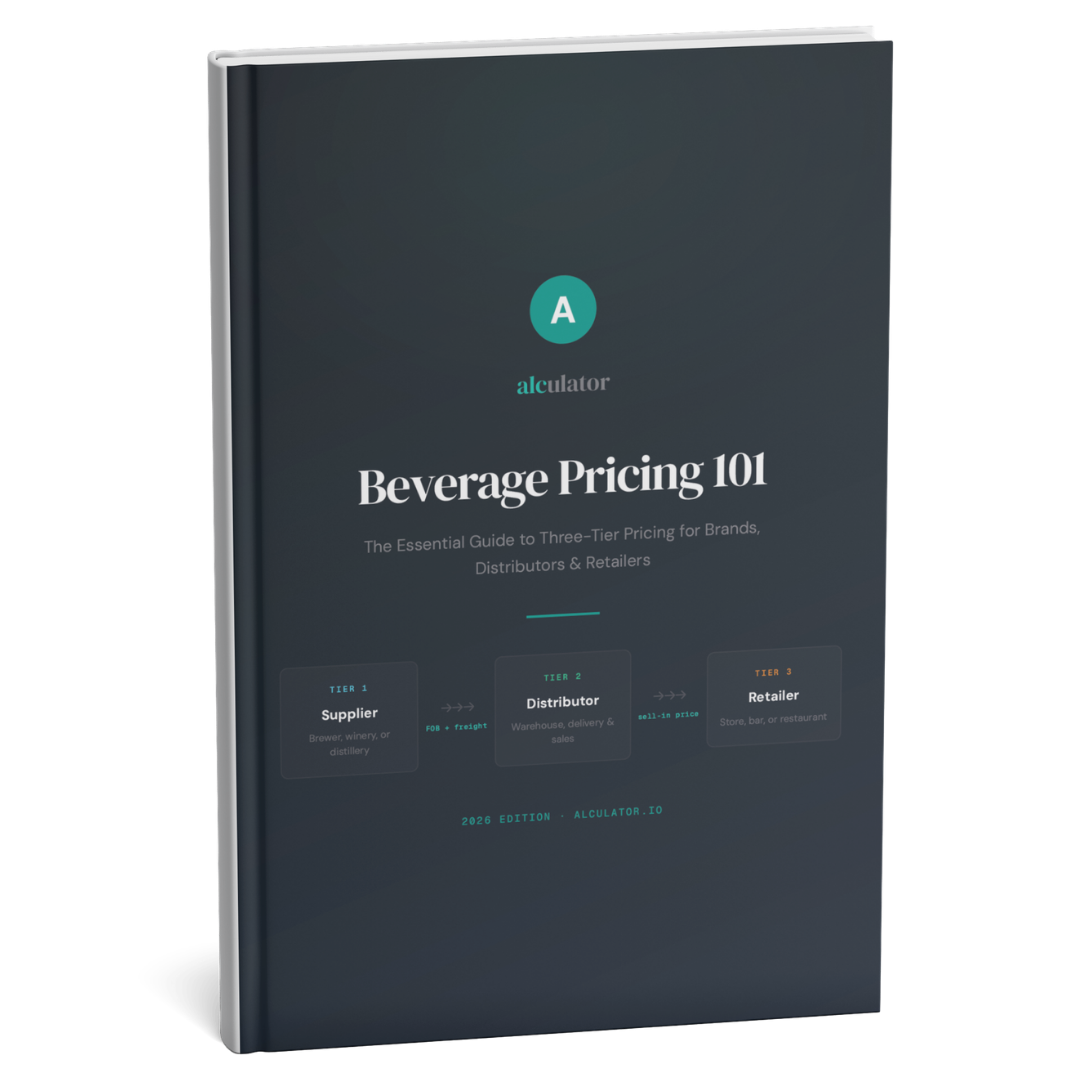
Beverage Pricing 101
The complete guide to three-tier pricing — margins, formulas, and benchmarks in one PDF.
No spam. Unsubscribe anytime.
Downloading your guide!
Defining fixed and variable costs
Fixed costs are expenses that remain constant over a given period regardless of production volume. Whether you produce 100 cases or 10,000 cases in a month, your fixed costs stay the same. These are the costs of simply being in business and having the capacity to produce product.
Variable costs, by contrast, change in direct proportion to the number of units you produce. If you double your production volume, your variable costs roughly double as well. These are the costs that are directly tied to making each individual case of product.
Common fixed costs in beverage production
- Facility lease or mortgage: Your production space, warehouse, and office rent remain the same whether the line is running or idle
- Equipment depreciation: Canning lines, fermentation tanks, bottling equipment, and refrigeration all depreciate on a schedule unrelated to production volume
- Insurance and licensing: Liability insurance, TTB permits, state licenses, and compliance costs are annual fixed expenses
- Salaried staff: Your brewmaster, operations manager, and administrative team are paid regardless of output
- Loan payments: Debt service on equipment financing or facility buildout is fixed on a monthly schedule
- Base utilities: Minimum utility charges for keeping facilities operational even at zero production
Common variable costs in beverage production
- Raw ingredients: Grain, hops, yeast, fruit, botanicals, hemp extract — all scale directly with batch size
- Packaging materials: Cans, bottles, labels, shrink wrap, trays, and cartons are purchased per unit — see our deep dive on packaging economics for a full breakdown
- Production labor: Hourly workers on the canning line, packaging crew, and warehouse staff paid per shift
- Utilities above baseline: Electricity, water, and gas consumed during active production runs
- Excise taxes: Federal and state excise taxes assessed per barrel, gallon, or proof gallon of product produced
- Freight and logistics: Shipping costs that scale with the number of cases moved
Important Distinction
Some costs blur the line between fixed and variable. These are called semi-variable or step-fixed costs. For example, you might need one shift supervisor for up to 5,000 cases per month, but once you exceed that volume, you need a second supervisor. Quality control testing might be a fixed cost per batch, but the number of batches scales with volume. Be honest about where your costs actually fall rather than forcing them into neat categories.
How costs flow into COGS and FOB
Your cost of goods sold (COGS) is the total cost to produce one case of finished product. It includes all variable costs directly attributable to production, plus the portion of fixed production overhead allocated to each case. COGS is the floor below which your FOB price cannot fall without losing money on every case sold. For a complete COGS breakdown for beverage production, see our dedicated guide.
Calculating COGS per case
To calculate COGS per case, start by summing all variable costs per case: ingredients, packaging, production labor, and excise taxes. Then allocate your fixed production overhead across your expected production volume. The more cases you produce, the lower the fixed cost allocation per case, which is the fundamental mechanism behind economies of scale.
| Cost Component |
Type |
1,000 Cases/Month |
5,000 Cases/Month |
10,000 Cases/Month |
| Ingredients |
Variable |
$10.00 |
$9.50 |
$9.00 |
| Packaging |
Variable |
$8.00 |
$7.20 |
$6.80 |
| Production labor |
Variable |
$4.00 |
$3.50 |
$3.20 |
| Excise tax |
Variable |
$0.25 |
$0.25 |
$0.25 |
| Facility & equipment |
Fixed |
$15.00 |
$3.00 |
$1.50 |
| Insurance & licensing |
Fixed |
$3.00 |
$0.60 |
$0.30 |
| Total COGS per case |
— |
$40.25 |
$24.05 |
$21.05 |
Notice how the total COGS drops dramatically as production scales. At 1,000 cases per month, fixed costs add $18.00 per case to your cost structure. At 10,000 cases, that fixed cost allocation drops to $1.80 per case. This is why volume is so critical for beverage brands — it is not just about revenue, it is about fundamentally changing your unit economics.
Watch Out
Many emerging brands set their FOB based on current low-volume COGS and then struggle when they realize their margins are too thin to fund marketing, sales support, and brand building. Always model your FOB against multiple volume scenarios to understand your true margin trajectory. Use Alculator's Reverse mode to work backwards from your target shelf price and see if the required FOB covers your projected costs.
Break-even analysis for beverage brands
Break-even analysis tells you how many cases you need to sell to cover all of your costs — both fixed and variable. Below the break-even point, you are losing money on every case. Above it, each additional case contributes directly to profit. Understanding your break-even volume is essential for setting realistic sales targets and making informed decisions about market expansion.
The break-even formula
The basic break-even calculation is straightforward: divide your total fixed costs by the contribution margin per case. Contribution margin is the difference between your FOB price and your variable cost per case. It represents the amount each case contributes toward covering fixed costs and generating profit.
For example, if your monthly fixed costs total $15,000, your FOB is $36.00 per case, and your variable costs are $22.00 per case, your contribution margin is $14.00 per case. Your break-even point is $15,000 ÷ $14.00 = 1,072 cases per month. Any cases sold beyond 1,072 generate $14.00 of profit each.
Sensitivity to FOB changes
Small changes in your FOB price have an outsized impact on break-even volume because they change your contribution margin. Dropping your FOB by $2.00 — from $36.00 to $34.00 — reduces your contribution margin from $14.00 to $12.00 and increases your break-even from 1,072 cases to 1,250 cases per month. That is a 17 percent increase in the volume you need just to cover costs, from a modest price concession. This is why protecting your FOB is so critical, especially in distributor negotiations.
Practical Tip
Build a simple break-even model alongside your Alculator pricing sheets. For each SKU, calculate the contribution margin at your current FOB and determine the monthly volume needed to break even. This gives you a clear minimum velocity target for each market and helps you evaluate whether a new distribution opportunity is financially viable.
Economies of scale and the growth inflection point
Economies of scale occur when increasing production volume decreases your per-unit cost. In beverage production, these economies come from three primary sources: spreading fixed costs over more cases, negotiating better pricing on raw materials and packaging at higher volumes, and improving production efficiency as your team gains experience with longer and more consistent runs.
Where the savings come from
Raw material discounts typically start at modest volumes. Ordering 10 pallets of cans instead of 2 might save you 10 to 15 percent on packaging costs. Committing to quarterly ingredient contracts can lock in lower prices than spot purchasing. Production efficiency improves as well — a canning line running for 8 hours straight has lower per-case labor and changeover costs than one running 4 separate 2-hour runs.
The growth inflection point for most beverage brands occurs when they reach a volume that fully utilizes their existing production capacity. At that point, fixed costs per case are minimized, and any additional volume either requires capital investment in new capacity (resetting the fixed cost equation) or a shift to co-packing.
Co-packing cost structures
Many beverage brands outsource production to contract packers (co-packers) rather than investing in their own facilities. Co-packing fundamentally changes the fixed vs. variable cost equation because the co-packer converts what would be your fixed production costs into variable per-case fees.
How co-pack pricing works
A typical co-packer charges a per-case fee that includes facility overhead, equipment usage, labor, and a profit margin. You provide the recipe and often the raw ingredients, and the co-packer handles production and packaging. This model eliminates most of your fixed production costs but comes with a higher variable cost per case than in-house production at scale.
For brands producing fewer than 3,000 to 5,000 cases per month, co-packing is often more economical than building out a dedicated production facility. The break-even point where in-house production becomes cheaper depends on your specific fixed cost structure and the co-pack rates available in your region. Typical co-pack fees for canned beverages range from $3.00 to $8.00 per case for production and packaging, on top of your ingredient and packaging material costs.
Make vs. buy decision framework
The decision to co-pack versus produce in-house comes down to comparing your total cost per case under each scenario at your projected volumes. At low volumes, co-packing almost always wins because you avoid the heavy fixed cost burden of a production facility. As volume grows, the crossover point approaches where the savings from owning your production outweigh the convenience and flexibility of co-packing.
Beyond pure cost, consider factors like quality control, recipe confidentiality, production scheduling flexibility, and the capital required for buildout. Many successful brands start with a co-packer and transition to in-house production only after they have proven market demand and secured the financing to invest in their own facility. This staged approach minimizes risk while allowing the brand to focus its early resources on pricing strategy and market development rather than production infrastructure.
Key Takeaway
Your cost structure determines your pricing flexibility. Brands with high fixed costs need volume to survive. Brands with high variable costs need margin to thrive. Understanding which cost profile you have — and how it changes as you grow — is the foundation for every pricing decision you will make in the three-tier system.
Ready to run your own numbers?
Open the calculator and model how different cost structures affect your FOB and shelf price.
Open the Calculator →