Fundamentals
The Three-Tier System, explained.
Why does a beer that costs $10 to produce end up on a shelf for $40? The answer is the three-tier distribution system — and once you understand it, you can price for it.
Why does a beer that costs $10 to produce end up on a shelf for $40? The answer is the three-tier distribution system — and once you understand it, you can price for it.
The three-tier system is the legal framework that governs how alcohol — and increasingly, hemp-derived beverages — moves from producer to consumer in the United States. Understanding it is the foundation of every pricing conversation you will have in the industry.
The three-tier system is the post-Prohibition legal structure that requires alcohol to pass from producer (Tier 1) to distributor (Tier 2) to retailer (Tier 3). Each tier is licensed separately and adds its own margin before the consumer buys.
Sell-in = landed cost ÷ (1 − distributor margin) → Shelf = sell-in ÷ (1 − retailer margin)
| Tier | Typical margin (2026) |
|---|---|
| Distributor | 25–35% |
| Retailer (off-premise) | 30–45% |
| On-premise (bar / restaurant) | 60–80% |
After Prohibition ended in 1933, the United States needed a framework to prevent the corruption and tied-house arrangements that had characterized the pre-Prohibition alcohol industry. The solution was a mandatory three-tier structure that separates the production, distribution, and retail sale of alcoholic beverages into distinct business entities.
Each tier is legally required to hold separate licenses and operate independently. In most states, a supplier cannot own a distributor, a distributor cannot own retail locations, and retailers cannot buy directly from producers. This separation is designed to maintain market competition, ensure tax collection, and promote responsible distribution of controlled substances. Before entering any tier, producers must secure the appropriate federal TTB licensing as a prerequisite for state-level permits.
Before Prohibition, large breweries and distilleries often owned the saloons that sold their products. These "tied houses" created anti-competitive monopolies, encouraged excessive consumption, and made regulation nearly impossible. When the 21st Amendment repealed Prohibition, states were given broad authority to regulate alcohol commerce within their borders, and virtually every state adopted some version of the three-tier model.
The system has evolved significantly since the 1930s, but its core principle remains: separating the financial interests of production, distribution, and retail creates checks and balances that no single tier can dominate. Whether you agree with the policy rationale or not, every brand that sells through licensed channels must price for this reality.
While the three-tier model is nearly universal, the details vary enormously by state. Some states operate as "control states" where the government itself acts as the distributor or retailer for certain categories. Others are "open states" where private enterprise fills all three tiers. Franchise laws in many states make distributor agreements effectively permanent, meaning the choice of distribution partner is one of the most consequential decisions a brand can make.
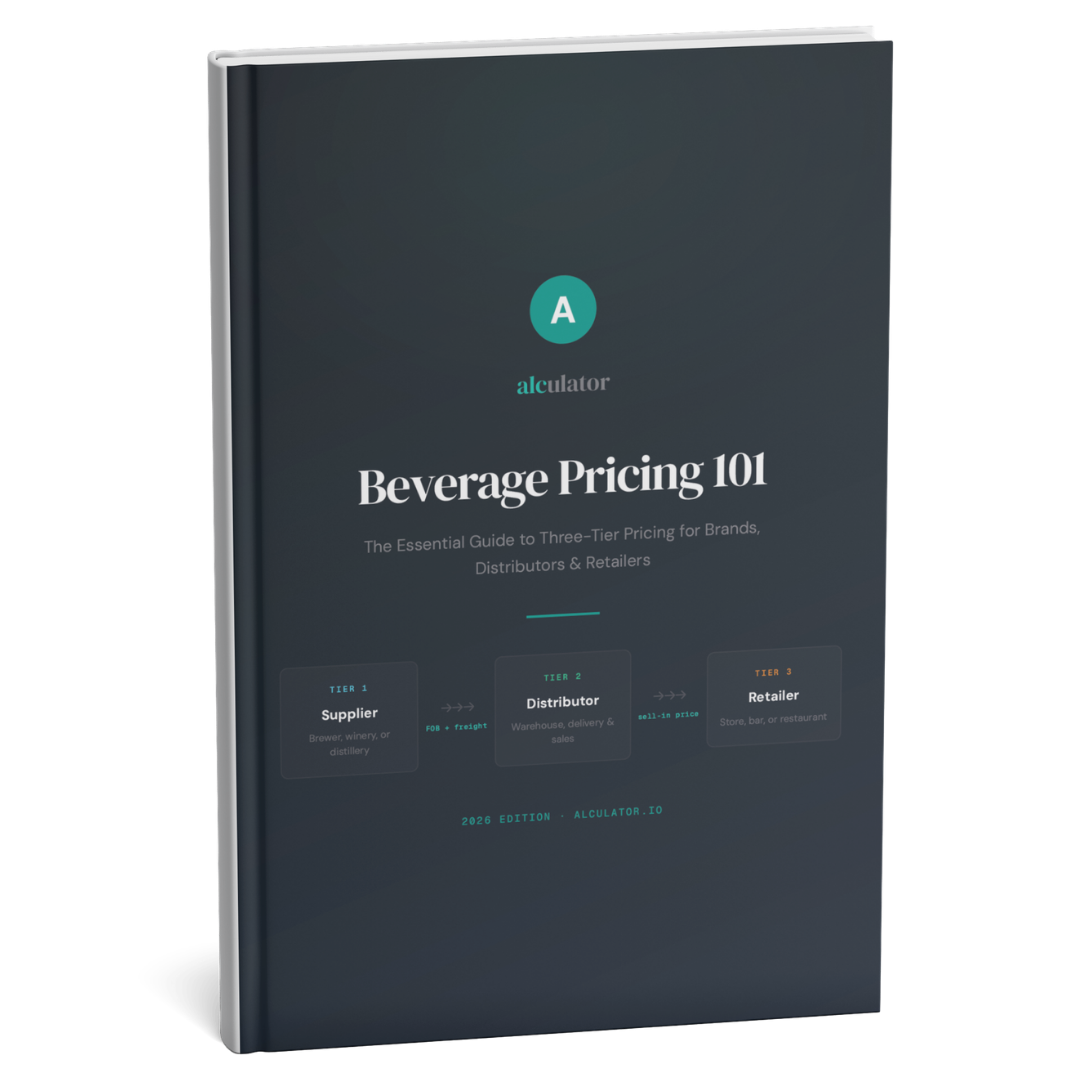
The complete guide to three-tier pricing — margins, formulas, and benchmarks in one PDF.
No spam. Unsubscribe anytime.
Every tier takes a margin — the percentage difference between what they pay and what they charge. The critical thing to understand is that these are gross margins, not markups. A 30% gross margin means the cost represents 70% of the selling price, not that 30% is added on top of cost.
If a distributor buys a case for $80 and takes a 30% gross margin, they sell it for $80 ÷ (1 − 0.30) = $114.29 — not $80 × 1.30 = $104. This distinction matters enormously when modeling your pricing stack. Alculator uses gross margin throughout, which is the industry standard. Read more in our Markup to Margin Calculator guide.
| Tier | Typical Margin | What Drives It |
|---|---|---|
| Distributor | 25% – 35% | Coverage area, portfolio size, brand priority, category |
| Retailer (off-premise) | 30% – 45% | Store format, competition, category, price tier |
| On-premise (bar/restaurant) | 60% – 80% | Service model, pour cost targets, draft vs. packaged |
These ranges are starting points. A high-velocity brand in a competitive market may negotiate tighter distributor margins to win shelf placement. A premium craft product at a specialty retailer may command even higher retail margins. The key is knowing your numbers before you walk into any negotiation.
FOB (Free On Board) is the price a supplier charges a distributor at the point of origin. But a distributor's actual cost per case — their landed cost — is FOB plus freight, plus any applicable excise taxes. These additions can be meaningful:
Alculator adds a "Freight + Tax" field per SKU so your landed cost — and therefore your sell-in and shelf pricing — reflects reality. For a deeper dive, see our guide to Landed Cost in Beverage Distribution.
Understanding the math behind each handoff is essential for setting viable pricing. Here is how a case of product moves from a supplier's dock to a consumer's hand, with dollars attached at every step.
In forward pricing, you start with what the supplier charges (FOB) and calculate what the consumer pays. This is the most common approach when a brand is launching a new product and wants to understand what the retail price will be given their production costs and desired margins.
Reverse pricing works backwards from a target shelf price to determine the FOB you need. This approach is essential when entering a market with established price points — if consumers expect a 4-pack of craft seltzer to cost $12.99, you need to know what FOB supports that target.
When setting FOB pricing, work backwards from your target shelf price. If you want a 4-pack to retail for $12.99 and your retailer takes 35% and distributor takes 30%, your FOB per case needs to be no more than $12.99 × (1−0.35) × (1−0.30) × packs per case. Alculator's Reverse mode does this math automatically.
The beverage industry communicates case sizes using a "packs × units" format. This shorthand describes how many retail packs are in a case and how many individual units are in each pack.
| Format | Total Units | Common Use |
|---|---|---|
| 6×4 | 24 | Standard craft beer, hard seltzer, hemp beverages — six 4-packs per case |
| 4×6 | 24 | Classic beer format — four 6-packs per case |
| 2×12 | 24 | Variety packs, high-velocity SKUs — two 12-packs per case |
| 2×9 | 18 | Emerging hemp beverage format — two 9-packs per case |
| 12×1 | 12 | Bombers, large-format cans — 12 individual units per case |
| 4×4 | 16 | Premium small-format packs — four 4-packs per case |
In the three-tier system, distributors always sell to retailers in full cases. Retailers then break cases to sell packs and individual units on the floor. Understanding this is essential when modeling retail pricing — you are calculating the cost of a pack, not a case, for shelf pricing purposes. Learn more in our detailed Case Formats guide.
The rise of hemp-derived beverages has added complexity to an already complex system. Depending on the state, hemp beverages may move through the traditional alcohol three-tier system, through alternative distribution channels, or a hybrid of both. Always verify your state's specific regulations before building a distribution strategy. See our Hemp Beverage Distribution guide for details.
Federal law changes on November 12, 2026: P.L. 119-37 caps finished hemp products at 0.4 mg total THC per container — below virtually every intoxicating hemp beverage sold today. How hemp routes through — or around — the three-tier system is about to be redrawn. See our hemp distribution guide for the full picture and the pending relief bills.
The three-tier system is not just a regulatory requirement — it is the economic reality that determines whether your product is viable at retail. A brand that sets its FOB price without understanding the cumulative effect of distributor and retailer margins will either price itself off the shelf or leave money on the table.
The most successful beverage brands approach the three-tier system as a partnership. They understand their distributor's cost structure, they respect their retailer's margin requirements, and they price their products so that every tier in the chain can operate profitably. When every tier wins, the product stays on the shelf and velocity grows.
Whether you are a first-time supplier trying to understand why your $30 case costs $15 on the shelf, or an experienced brand manager optimizing a 50-SKU portfolio, the math is the same. The three-tier system adds cost at every handoff, and the only way to control it is to understand it.
Open the calculator and model your full SKU portfolio in under two minutes.
Open the Calculator →