For most beverage brands, freight is the second-largest variable cost after the product itself. A case of craft beer that costs $32 at FOB can land at $35 or $38 depending on distance, shipping mode, and seasonal demand — and that difference cascades through the entire three-tier system to change the retail shelf price by several dollars. Mastering freight logistics is not optional. It is a core competency for any brand that wants to expand beyond its home market.
Free Download
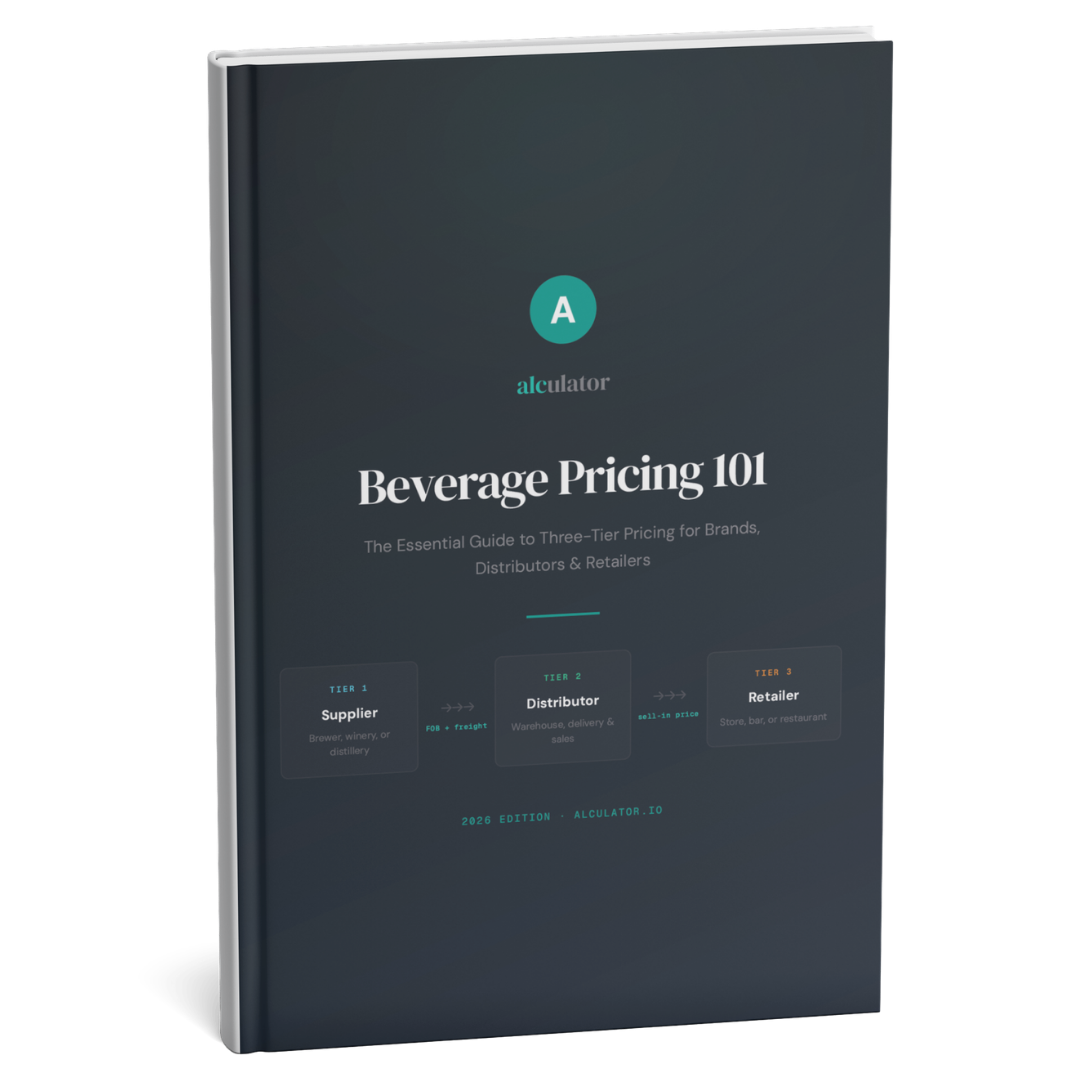
Beverage Pricing 101
The complete guide to three-tier pricing — margins, formulas, and benchmarks in one PDF.
No spam. Unsubscribe anytime.
Downloading your guide!
Types of beverage shipping
The beverage industry relies on three primary shipping modes, each with distinct cost structures, capacity thresholds, and use cases. Choosing the right mode for each shipment is one of the most impactful decisions a brand or distributor can make.
LTL (less-than-truckload)
LTL shipping means your product shares trailer space with freight from other shippers. You pay for the portion of the truck your pallets occupy, typically measured in pallet positions or by weight class. LTL is the default mode for smaller shipments — anything from a single pallet up to roughly 10 pallets. For emerging brands shipping 50 to 300 cases at a time, LTL is often the only practical option.
The trade-off is cost per case. Because the carrier must make multiple stops to pick up and deliver various shippers' freight, transit times are longer and handling is more frequent. Every additional touch point increases the risk of damage, and the per-case rate is significantly higher than full truckload. Expect to pay anywhere from $3 to $8 per case on LTL shipments depending on distance and carrier.
FTL (full truckload)
Full truckload shipping means you fill an entire 53-foot trailer with your product. A standard trailer holds 20 to 26 pallets depending on pallet height and weight restrictions, which translates to roughly 1,100 to 1,600 cases for most beverage formats. FTL shipments move point-to-point without intermediate stops, which means faster transit, less handling, and lower per-case freight costs.
FTL becomes economically viable when your order volume consistently fills a trailer. For a regional shipment of 1,200 cases, the per-case freight cost on FTL might be $1.50 to $2.50 compared to $4.00 or more on LTL for the same lane. The challenge for smaller brands is accumulating enough volume to fill trucks consistently. This is where consolidation strategies and partnerships with distributors who aggregate multiple supplier shipments become valuable.
Dedicated fleet
Some large beverage companies and major distributors operate their own truck fleets. A dedicated fleet gives you complete control over routing, scheduling, and service quality, but it requires substantial capital investment in vehicles, maintenance facilities, insurance, and driver payroll. This model only makes economic sense at very high volumes — typically thousands of cases per day across a defined service territory.
Most emerging and mid-size brands will never operate a dedicated fleet. However, understanding that your distributor may use one is important because it affects how they think about freight costs internally and how willing they are to absorb or pass through those costs in their pricing.
Freight cost by distance
Distance is the single largest driver of per-case freight cost, but the relationship is not perfectly linear. Short-haul routes have a higher cost per mile due to fixed loading and unloading time, while long-haul routes spread those fixed costs over more miles but accumulate fuel, driver, and equipment charges. The table below provides benchmark ranges for standard dry freight on beverage cases.
| Shipping Zone |
Distance |
Cost per Case |
Typical Mode |
| Local |
0 – 100 miles |
$0.50 – $1.00 |
FTL / Distributor fleet |
| Regional |
100 – 500 miles |
$1.00 – $3.00 |
FTL / LTL |
| Inter-regional |
500 – 1,000 miles |
$2.50 – $4.50 |
FTL |
| National |
1,000 – 2,500 miles |
$3.00 – $6.00 |
FTL / Rail + truck |
| Cross-country |
2,500+ miles |
$5.00 – $8.00+ |
FTL / Intermodal |
These ranges assume standard palletized beverage cases at typical weight. Heavier formats like glass bottles or cases with higher liquid volume will trend toward the upper end of each range. Lighter formats like slim cans in paperboard trays will trend lower.
Why Freight Matters for FOB
Your FOB price is what the distributor pays at your dock. But the distributor's real cost is the landed cost — FOB plus freight, taxes, and fees. A brand with a $30 FOB shipping locally at $0.75 per case has a landed cost of $30.75. The same brand shipping cross-country at $6.00 per case has a landed cost of $36.00. That $5.25 difference amplifies to roughly $11 to $15 more at retail depending on margin structures. This is why many brands price differently by region or establish regional production to compress freight costs.
Fuel surcharges and accessorials
The base freight rate you are quoted is rarely the final number on your invoice. Carriers add fuel surcharges and various accessorial fees that can increase the total cost by 10% to 25% or more.
How fuel surcharges work
Fuel surcharges are calculated as a percentage of the base linehaul rate and fluctuate with the national average diesel price published by the U.S. Department of Energy each week. Most carriers use a sliding scale: when diesel is at a defined baseline (often around $1.20 per gallon), the surcharge is zero. For every incremental increase in fuel price, the surcharge rises by a set percentage. In practice, fuel surcharges typically add 5% to 15% to the base freight rate, though they have spiked above 25% during periods of extreme fuel price volatility.
For example, a base freight rate of $2,400 for a full truckload with a 12% fuel surcharge becomes $2,688 — an additional $288 that translates to roughly $0.20 to $0.25 more per case on a 1,200-case load. This may seem small on a per-case basis, but across thousands of cases per month it adds up quickly and must be factored into your pricing model.
Common accessorial charges
- Liftgate delivery: Required when the delivery location lacks a loading dock. Adds $75 to $150 per delivery
- Lumper fees: Charges for third-party labor to unload the truck at the destination warehouse. Common at large distributor facilities and can run $150 to $350 per load
- Detention time: If a truck waits longer than the allotted free time (usually 2 hours) at pickup or delivery, carriers charge $50 to $100 per hour
- Residential delivery: Deliveries to non-commercial addresses incur a surcharge, typically $50 to $100. Relevant for direct-to-consumer brands fulfilling online orders
- Redelivery fees: If a shipment cannot be delivered on the first attempt due to a closed facility or incorrect address, carriers charge $150 to $300 for a second attempt
Cold chain and temperature-controlled shipping
Many beverage categories require temperature-controlled transportation. Fresh juices, kombucha, probiotic drinks, cold-brew coffee, and certain craft beers with live cultures all need to maintain a consistent temperature range from production through delivery. Even products that are technically shelf-stable, like many craft beers and ciders, can suffer quality degradation if exposed to high temperatures during transit.
Reefer trucks and their costs
Temperature-controlled trailers, known as reefers, use a diesel-powered refrigeration unit mounted on the front of the trailer. Reefer shipping costs 15% to 30% more than dry freight for the same lane and load size. The premium covers the refrigeration equipment, additional fuel consumption for the reefer unit, and the specialized maintenance these trailers require.
For a regional FTL shipment that might cost $1,800 for dry freight, the reefer equivalent could run $2,200 to $2,400. On a per-case basis for a 1,200-case load, that is an additional $0.35 to $0.50 per case. For products that absolutely require cold chain, this cost is non-negotiable and must be built into your landed cost calculations from day one.
Seasonal considerations
Temperature becomes an even larger concern during summer months. Even shelf-stable beverages can be damaged when trailer interior temperatures exceed 100°F during cross-country summer hauls. Some brands that ship dry freight in the cooler months switch to reefer or insulated trailers from June through September. Others specify maximum transit times during summer to minimize heat exposure. These seasonal adjustments add cost and complexity but protect product quality and reduce the risk of retailer chargebacks for damaged inventory.
Practical Tip
If your product is temperature-sensitive, build reefer freight costs into your annual budget at the higher summer rate and treat any savings during cooler months as a bonus. This prevents the common mistake of budgeting for dry freight year-round and then scrambling to absorb reefer premiums when summer hits. In Alculator, you can create seasonal pricing scenarios by adjusting the Freight + Tax field to reflect summer versus winter shipping costs and see how each scenario affects your margins.
The role of 3PL providers
Third-party logistics providers, commonly called 3PLs, act as intermediaries between shippers and carriers. They do not typically own trucks. Instead, they aggregate freight from multiple shippers, negotiate volume rates with carriers, and manage the logistics of booking, tracking, and invoicing shipments. For beverage brands, 3PLs can provide several advantages.
First, 3PLs have established carrier networks and can often secure better rates than a small brand negotiating on its own. A 3PL that moves thousands of beverage loads per year has far more leverage with carriers than a brand shipping 20 loads per month. Second, 3PLs handle the operational complexity of freight management — booking pickups, tracking shipments in transit, resolving delivery issues, and processing freight claims for damaged product. This frees the brand to focus on production and sales rather than logistics operations.
Third, many beverage-focused 3PLs offer value-added services like warehouse storage, order consolidation, and inventory management. A 3PL with a strategically located warehouse can receive full truckloads from your production facility, store inventory, and fulfill smaller LTL orders to individual distributors as needed. This hub-and-spoke model can dramatically reduce your overall freight spend compared to shipping small orders directly from your brewery or production facility to each distributor.
The trade-off is cost. 3PLs charge management fees, typically structured as a percentage markup on freight (10% to 20%) or a flat per-shipment fee. Some also charge monthly account management fees. You need to weigh these costs against the rate savings and operational efficiency they provide. For brands shipping fewer than 10 loads per month, a 3PL almost always makes economic sense. For brands shipping 50 or more loads per month, bringing freight management in-house or negotiating directly with carriers may yield better rates.
Seasonal freight variations
Freight capacity and pricing follow predictable seasonal patterns that every beverage brand should anticipate and plan for. Understanding these cycles helps you avoid sticker shock and maintain consistent landed costs throughout the year.
Summer peak season
Beverage demand peaks in summer, which means more shipments competing for the same pool of trucks and drivers. Spot market rates (rates for non-contracted shipments) can increase 15% to 30% from June through August compared to spring baseline. At the same time, produce season puts additional pressure on reefer capacity, making temperature-controlled trucks especially scarce and expensive during the exact months when many beverage brands need them most.
Holiday and year-end surcharges
The period from late October through mid-January brings holiday shipping surcharges from most carriers. Retail holiday inventory builds, combined with reduced driver availability around Thanksgiving and Christmas, push rates up by 10% to 20%. Beverage brands shipping seasonal holiday packs or building inventory for New Year's Eve need to account for these surcharges in their planning. Booking holiday freight early — ideally in September — and locking in contracted rates can mitigate some of this premium.
Q1 soft season
January through March is typically the softest period for freight demand. Rates drop, capacity is abundant, and carriers are more willing to negotiate favorable terms. Smart brands use this window to pre-position inventory in regional warehouses ahead of the spring and summer selling seasons, locking in lower freight costs and ensuring product availability when demand ramps up.
Palletization and weight considerations
How you configure your product on pallets directly affects freight costs. Carriers price based on either weight or space (whichever yields the higher revenue), so optimizing your pallet configuration is a straightforward way to reduce per-case shipping costs.
Standard pallet configurations
The standard shipping pallet in North America is 48 inches by 40 inches (GMA pallet). Most carriers set a maximum pallet height of 48 to 60 inches including the pallet itself, and maximum weight per pallet position of 2,000 to 2,500 pounds. A typical case of 24 × 12oz cans weighs approximately 20 to 22 pounds. Stacked five layers high with 12 cases per layer, a pallet holds 60 cases at roughly 1,300 pounds — well within weight limits and leaving room for additional height if the carrier and warehouse allow it.
For heavier formats like glass bottles, weight becomes the constraint before space. A case of 12 × 750ml glass bottles can weigh 35 to 40 pounds. At five layers of eight cases, you might hit 1,600 to 2,000 pounds per pallet with only 40 cases. Understanding these constraints helps you calculate accurate per-case freight costs and avoid overweight charges from carriers.
Maximizing trailer utilization
A full 53-foot trailer can accommodate 20 to 26 standard pallets depending on pallet height and whether you are single-stacking or double-stacking. For lightweight products in cans, you might fit 26 pallets at 60 cases each (1,560 cases) but weigh only 34,000 pounds — well under the 44,000-pound legal limit. For heavy glass products, you might only fit 20 pallets at 40 cases each (800 cases) before hitting weight limits. The per-case freight cost difference between 1,560 cases and 800 cases on the same truck is dramatic — the lighter, more space-efficient product ships for nearly half the per-case rate.
Key Takeaway
Packaging format decisions made in product development have lasting freight cost implications. Switching from glass to aluminum, or from a 12-pack to a more space-efficient 24-pack case configuration, can reduce per-unit freight costs by 20% to 40%. Always model freight alongside COGS when evaluating packaging options, and use Alculator to see how different freight costs per case affect your full margin stack from FOB through retail.
Strategies for reducing freight costs
Freight is a variable cost, but it is not a fixed percentage of your business. There are concrete strategies to compress freight spend and improve your per-case economics.
Regional production and co-packing
If freight is a large component of your landed cost in distant markets, consider contract manufacturing or co-packing in those regions. Producing closer to the point of consumption eliminates or drastically reduces the longest and most expensive freight lanes. Several national beverage brands produce at multiple facilities across the country specifically to minimize freight. For smaller brands, partnering with a co-packer in a key market can achieve the same result without the capital investment of building a new facility. Building broader supply chain resilience — including diversified carriers, backup warehousing, and contingency routing — protects your brand against the freight disruptions that can turn a manageable cost into a margin crisis.
Consolidating shipments
Shipping partial loads is expensive on a per-case basis. Whenever possible, consolidate orders to fill full trucks. Work with your distributors to establish regular order cycles (bi-weekly or monthly) that accumulate enough volume for FTL shipments. If your volume to a single distributor does not justify FTL, look for consolidation opportunities with other brands shipping to the same market. Many 3PLs specialize in building multi-stop truckloads that combine shipments from several suppliers into a single full truck.
Negotiating annual contracts
Spot market freight rates are volatile. Locking in annual or semi-annual contracts with carriers or 3PLs provides rate stability and typically offers a 5% to 15% discount versus spot rates. Contracts require volume commitments, but even committing to a minimum number of loads per month or quarter gives you better rates and guaranteed capacity during peak seasons when spot trucks are scarce and expensive.
Optimizing order quantities
Work with your distributors to find the order quantity sweet spot that balances their inventory needs with your freight economics. A distributor ordering 200 cases every two weeks might pay $3.50 per case in LTL freight, while an order of 600 cases monthly could ship FTL at $1.75 per case. Offering freight incentives for larger orders — such as free freight on orders above a certain case count — can shift distributor behavior and reduce your average freight cost significantly.
Modeling freight in Alculator
Alculator's Freight + Tax field is designed to capture all logistics costs that sit between your FOB price and the distributor's landed cost. Here is how to use it effectively for freight modeling.
Enter your total per-case freight cost as a dollar amount. This should include the base freight rate, fuel surcharge, and any accessorial charges divided across the cases in the shipment. For example, if a 1,200-case FTL shipment costs $2,400 in base freight plus a $300 fuel surcharge plus $200 in lumper fees, your total is $2,900. Divide by 1,200 cases to get $2.42 per case. Enter $2.42 in the Freight + Tax field.
If you also have per-case excise taxes or other fees, add them to the freight number for a single combined entry. The calculator will add this amount to your FOB to compute the landed cost, then apply distributor and retailer margins from that landed cost basis. This gives you a complete view of how freight affects every price point in the chain.
For brands shipping to multiple markets at different freight rates, create separate rows in Alculator for each market. A single SKU might have three rows: one for local distribution at $0.75 freight, one for regional at $2.00, and one for national at $4.50. This lets you compare margin structures across markets side-by-side and make informed decisions about where to invest in distribution expansion. For a framework on phasing market entry to optimize freight costs, see our guide to regional distribution strategy.
Pro Move
Run two scenarios in Alculator for every new market entry: one at your current freight rate and one at a rate 20% higher. This stress-tests your margins against freight volatility and ensures you are not building a distribution plan that only works when shipping rates are at their floor. If your margins collapse at the higher rate, you may need to adjust your FOB or negotiate tighter distributor margins before committing to that market.
Ready to model your freight costs?
Open the calculator and see how freight impacts your margins across every tier.
Open the Calculator →