Co-packing — short for contract packaging — is the practice of hiring a licensed production facility to manufacture and package your beverage product. For brands without their own production capacity, it is the fastest path to market. For facilities with excess capacity, it is a revenue stream that can transform idle equipment into consistent cash flow.
What is co-packing?
At its core, co-packing is an outsourced production arrangement. A brand owner develops the recipe, secures the brand identity, and handles sales and marketing, while a co-packing facility handles liquid production, canning or bottling, and quality control. The finished product ships from the co-packer’s dock directly to distributors or fulfillment centers.
The co-packing model has exploded in beverages for one simple reason: building a production facility requires $2–10 million in capital expenditure, while a co-packing agreement can put product on shelves for as little as $50,000–100,000 in initial orders. This capital efficiency is why co-packing drives the majority of new beverage brand launches.
Who uses co-packers?
Co-packing is not just for startups. Established brands frequently use co-packers to handle overflow production, test new SKUs, enter new geographic markets, or produce seasonal and limited-edition releases without disrupting their core production schedules. Even brands with their own facilities may co-pack 20–40% of their total volume.
- Startup brands — no production facility, need full-service manufacturing
- Growth-stage brands — own facility at capacity, need overflow production
- National brands — need regional production to reduce freight costs
- Innovation teams — testing new formulations before committing to in-house production
Industry Context
The three-tier system adds complexity to co-packing arrangements. The brand owner — not the co-packer — typically holds the supplier license and sets FOB pricing for distributors. However, in some states the co-packer can hold the production license while the brand owner operates under an alternating proprietorship arrangement.
Private label vs. contract manufacturing
The terms “private label” and “contract manufacturing” are often used interchangeably, but they represent meaningfully different business models with distinct economics.
| Dimension |
Private Label |
Contract Manufacturing |
| Recipe ownership |
Co-packer develops or owns the formula |
Brand owner develops and owns the formula |
| Brand identity |
Retailer or brand applies their own label |
Brand owner controls all branding |
| Typical customer |
Retailers, restaurant groups, regional chains |
Beverage brands, DTC companies |
| MOQ expectations |
Often lower (500–2,000 cases) |
Higher (2,000–10,000+ cases) |
| Per-unit cost |
Lower (standardized production) |
Higher (custom formulation runs) |
| Exclusivity |
Rarely exclusive — same liquid, different labels |
Typically exclusive to the brand |
Private label is the simpler, lower-risk entry point. A grocery chain that wants a store-brand sparkling water can choose from a co-packer’s existing formulations, apply their label, and go to shelf in weeks. Contract manufacturing is more involved but produces a differentiated product that the brand fully owns.
The hybrid model
Many co-packers now offer a hybrid approach: they provide a base formulation that the brand can customize with flavor profiles, functional ingredients, or sweetener choices. This gives brands some differentiation without the full cost of R&D, and gives co-packers the efficiency of standardized production with minimal changeovers.
Free Download
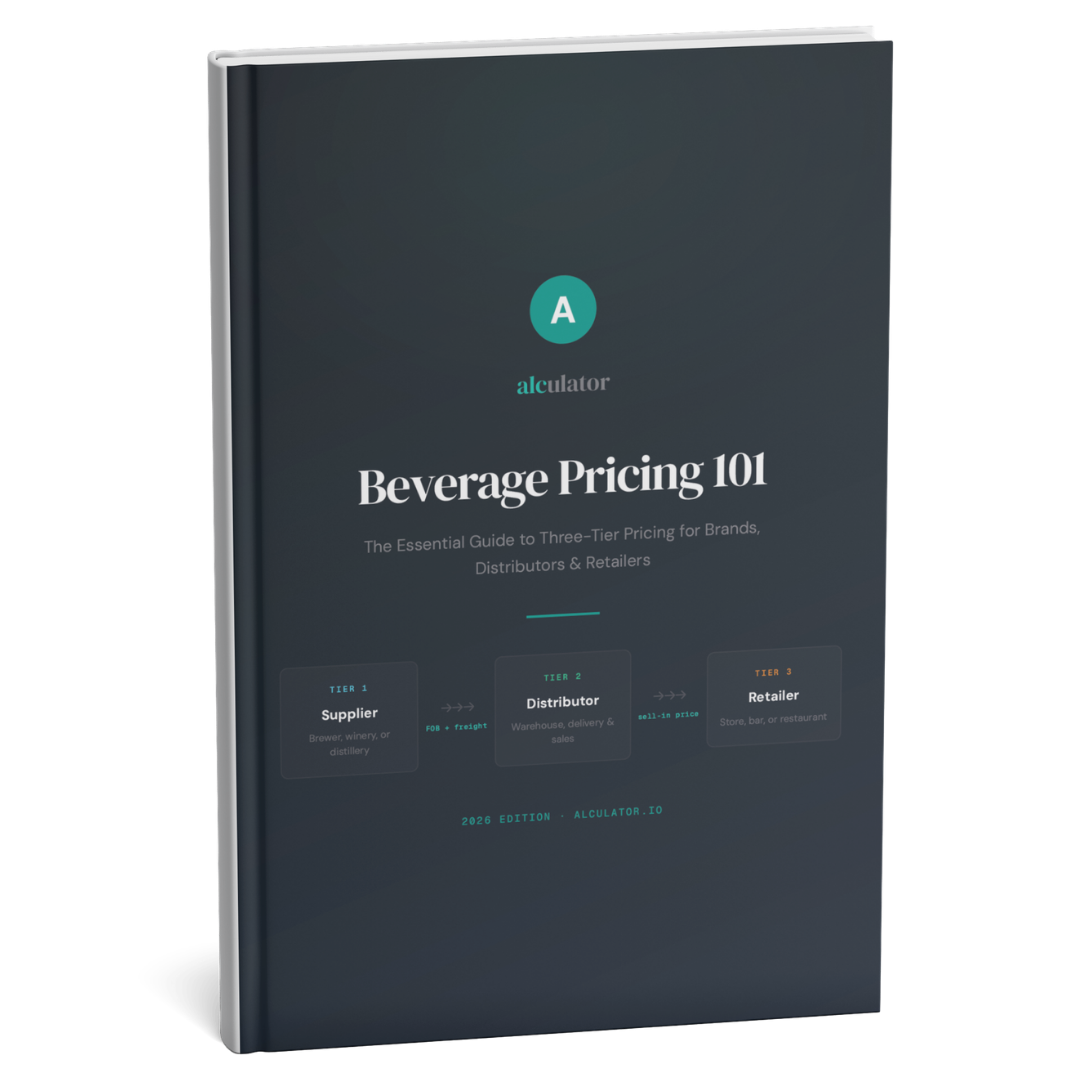
Beverage Pricing 101
The complete guide to three-tier pricing — margins, formulas, and benchmarks in one PDF.
No spam. Unsubscribe anytime.
Downloading your guide!
Co-packing economics
Understanding the cost structure of co-packing is essential for building viable FOB pricing. Co-packing costs are typically quoted on a per-case or per-unit basis and include several distinct components.
| Cost Component |
Typical Range (per case, 24-ct) |
% of Total |
| Raw materials (liquid) |
$3.00 – $8.00 |
15–30% |
| Packaging (cans, lids, carriers) |
$5.00 – $9.00 |
25–40% |
| Production labor |
$1.50 – $3.50 |
8–15% |
| Overhead & facility |
$1.00 – $2.50 |
5–12% |
| QC & compliance |
$0.50 – $1.50 |
3–6% |
| Co-packer margin |
$2.00 – $5.00 |
10–20% |
For a standard 12 oz can in a 24-count case, total co-packing costs typically land between $14 and $28 per case, depending on ingredients, packaging choices, and volume. This is the brand’s effective COGS — the foundation on which all FOB and retail pricing is built.
Volume Drives Everything
Co-packing costs are highly volume-sensitive. A brand ordering 1,000 cases per run will pay 25–40% more per case than one ordering 10,000 cases. This is driven by changeover time (line setup, cleaning, label changeovers), material purchasing power, and capacity utilization. Always negotiate pricing at your projected 12-month volume, not your initial order.
The hidden costs
Beyond the per-case production cost, several additional expenses catch first-time brand owners off guard:
- Label printing — $0.03–0.08 per can for shrink sleeves; less for printed cans at higher minimums
- Flavor development — $3,000–15,000 per SKU for custom formulations
- Lab testing — $500–2,000 per SKU for nutritional panels and compliance testing
- Warehousing — $1.50–3.00 per pallet per week if the co-packer stores finished goods
- Minimum run charges — some co-packers charge a flat fee ($2,000–5,000) for short production runs
Contract structures & terms
Co-packing contracts vary widely, but several key terms directly impact your economics and flexibility. Understanding these terms before signing is far more valuable than negotiating after you are locked in.
Minimum order quantities (MOQs)
MOQs are the single biggest variable in co-packing negotiations. They protect the co-packer’s production efficiency but can strain a brand’s cash flow and inventory management.
| Facility Size |
Typical MOQ |
Production Speed |
Best For |
| Micro co-packer |
200–500 cases |
50–100 cans/min |
Startups, test runs, R&D |
| Regional co-packer |
1,000–5,000 cases |
200–600 cans/min |
Growing brands, regional launches |
| National co-packer |
5,000–20,000 cases |
800–1,500 cans/min |
Established brands, national distribution |
| Enterprise co-packer |
20,000+ cases |
1,500+ cans/min |
Major brands, private label programs |
Key contract terms to negotiate
- Exclusivity radius — prevent the co-packer from producing competing products within your category or geography
- Price escalation clauses — tie cost increases to published indices (aluminum, sugar, freight) rather than allowing open-ended increases
- Quality specifications — define acceptable fill levels, carbonation, shelf life, and defect rates in writing
- Intellectual property — ensure your recipe, formulation notes, and brand assets remain your property if you change co-packers
- Termination provisions — negotiate 60–90 day exit clauses rather than the 6–12 month lockups that many co-packers prefer
- Insurance requirements — verify the co-packer carries adequate product liability coverage ($2M+ is standard)
Co-packing relationships are governed by similar contract principles as distributor agreements. Both require clear terms around exclusivity, pricing adjustments, and exit provisions to protect both parties.
Negotiation Tip
Request a “trial run” clause that allows you to produce 1–2 batches before committing to a long-term agreement. Most reputable co-packers will agree to this because it benefits both sides — they demonstrate capability, and you validate quality before scaling.
Distribution considerations
Co-packed products enter the same distribution channels as self-produced beverages, but several logistics considerations are unique to the co-packing model.
Shipping from the co-packer
Where your co-packer is located relative to your distribution markets directly impacts landed cost. A brand based in New York using a co-packer in California will add $3–6 per case in cross-country freight, potentially making their product uncompetitive on the shelf. Strategic co-packer selection should factor in proximity to your top 3–5 distribution markets.
Inventory management
Co-packing creates a cash flow dynamic that differs from self-production. You pay for production in large batches but sell through gradually. A typical 5,000-case production run at $20/case ties up $100,000 in inventory. Managing production timing against seasonal demand curves and distributor order patterns is critical for cash flow health.
- Spring/summer surge — plan production runs 6–8 weeks ahead of peak demand
- Depletion matching — coordinate production schedule with distributor depletion reports
- Shelf life awareness — most canned beverages have 9–12 month shelf life; avoid overproduction that leads to short-dated inventory
Licensing and compliance
In most arrangements, the brand owner must hold their own federal and state production permits — even when a co-packer physically manufactures the product. This typically means obtaining an alternating proprietorship agreement or brand registration at the co-packer’s facility. The licensing requirements vary significantly by state and by whether the product is a malt beverage, wine, or spirit.
Building your co-packing strategy
Whether you are evaluating co-packers for the first time or renegotiating an existing relationship, a structured approach will save you money and prevent the operational nightmares that derail many early-stage brands.
Step 1: Define your production requirements
Before contacting co-packers, document your exact specifications: liquid type (carbonated, still, hot-fill), alcohol content (if applicable), can size (12 oz, 16 oz, slim), pack format (4-pack, 6-pack, 12-pack), case configuration, annual volume projection, and any special requirements (organic certification, gluten-free, allergen-free facility).
Step 2: Request quotes from 3–5 facilities
Always get multiple quotes. Co-packing pricing varies enormously based on the facility’s current capacity utilization, their existing equipment match to your product, and their interest in your category. A facility running at 60% capacity will price 15–25% lower than one at 90% capacity.
Step 3: Evaluate beyond price
The lowest per-case cost is rarely the best choice. Evaluate quality track record, production flexibility (can they handle demand spikes?), communication responsiveness, geographic location relative to your markets, and references from current brand partners. A co-packer that delivers consistent quality and reliable scheduling is worth a premium over one that offers the lowest price but misses delivery windows.
Step 4: Model your full landed cost
Take your co-packing cost per case and add freight to your primary warehouse or distributor, excise taxes (if applicable), and any warehousing fees. This gives you your true cost basis for setting FOB pricing. Use the Alculator calculator to model how different co-packing costs flow through to retail shelf price.
Ready to price your co-packed product?
Enter your co-packing cost as COGS and model the full three-tier pricing stack in under two minutes.
Open the Calculator →