Chapter 1
The Economics of Getting a Beverage to Shelf
Why does a $2 can cost $4 at retail? The three-tier system isn't just regulation — it's the economic framework that determines whether your product survives or dies on the shelf.
Why does a $2 can cost $4 at retail? The three-tier system isn't just regulation — it's the economic framework that determines whether your product survives or dies on the shelf.
Imagine you've created an incredible craft beverage. The liquid is perfect, the branding is sharp, and early feedback is overwhelmingly positive. You've calculated your production cost at roughly $1.50 per can, and you figure a $3.99 retail price gives you plenty of room to profit. Then you sit down with a distributor for the first time and realize the math doesn't work the way you thought it did. Between your production floor and the retail shelf, there are hands that need to touch your product, warehouses that need to store it, trucks that need to deliver it, and every single one of those steps costs money. Understanding that journey — and the economics behind it — is the difference between a brand that scales and one that quietly disappears.
If you're in the beverage industry, you've heard of the three-tier system. Most people know the basics: it's a regulatory framework that separates suppliers, distributors, and retailers into distinct tiers. What gets less attention is that it's also an economic system — one that dictates how money flows from consumer back to producer, and how much of it each participant gets to keep.
The three-tier system was established after Prohibition to prevent monopolistic control of alcohol distribution. But its structure has become the de facto framework for how most beverages — alcoholic and increasingly non-alcoholic — move through the supply chain in the United States. Even brands that sell direct-to-consumer or through alternative channels need to understand it, because the moment you enter traditional retail distribution, you're playing by these rules.
Here's what matters for pricing: each tier exists because it provides real value, and each tier needs to earn enough margin to justify that value. If any single tier can't make money on your product, the chain breaks.
Tier 1 — Supplier (You): The brand or producer. You manufacture the product and sell it to distributors at your FOB (Free On Board) price. Your margin needs to cover production costs, overhead, marketing, and profit.
Tier 2 — Distributor: The middleman. Distributors buy from you, warehouse the product, and sell it to retailers and on-premise accounts. Their margin covers warehousing, refrigerated trucks, sales reps, delivery labor, and their own profit.
Tier 3 — Retailer: The point of sale. Retailers buy from distributors and sell to the end consumer. Their margin covers shelf space, labor, shrinkage (theft, breakage, expiration), overhead, and profit.
The critical insight is that none of these tiers are optional cost centers you can negotiate away. Distributors aren't overcharging you — they're running a capital-intensive logistics operation. Retailers aren't being greedy — they're allocating finite shelf space to the products that generate the most profit per linear foot. Every participant in the chain has real costs and legitimate margin requirements, and your pricing strategy needs to account for all of them.
Abstract percentages don't stick. Let's walk through a concrete example so you can see exactly how a case of product moves through the chain and what happens to the price at each step.
Say you're a craft soda brand selling a 4×6 case (four six-packs of 12oz cans — 24 cans per case). Your FOB price — the price you charge the distributor per case at your dock — is $18.00. Here's what happens next:
| Line Item | Amount |
|---|---|
| FOB / Case | $18.00 |
| Freight + Tax | $2.00 |
| Landed Cost | $20.00 |
| Distributor Margin (30%) | $8.57 |
| Distributor Sell-In | $28.57 |
| Retail Margin (35%) | $15.38 |
| Retail Price / Case | $43.96 |
| Pack Price (6×4) | $7.33 |
| Single Can (12oz) | $1.83 |
Look at what happened. You started at $18 per case and ended at nearly $44 at retail. The consumer pays roughly 2.4 times your FOB price. That multiplier isn't unusual — in fact, it's on the lower end for many categories. For premium spirits, the multiplier from FOB to retail shelf can be 3x or more.
Now look at it from the consumer's perspective. They see a six-pack on the shelf for $7.33. Is that a good price for craft soda? It depends entirely on the competitive set. If mainstream craft sodas in that store are priced at $5.99 to $6.49 per six-pack, your product has a problem — not because your production costs are too high, but because the cumulative margin structure pushed you past the price ceiling for your category.
This is why pricing in the three-tier system is fundamentally different from pricing a product you sell directly to consumers. You don't get to simply add your desired margin to your costs and call it a day. You have to account for every margin between you and the consumer, then check whether the final number makes sense in the real world.
New brands often focus exclusively on their own margin. That's understandable — you need to stay in business. But the harsh reality of the three-tier system is that if any participant in the chain can't make adequate margin on your product, your product won't survive.
Distributors typically need 25–35% gross margin on your product. That margin funds their warehouse space (often refrigerated), their fleet of delivery trucks, the route sales reps who place and maintain your product in stores, the back-office staff handling invoicing and compliance, and their own profit. A distributor carrying 500+ SKUs is constantly evaluating which products earn their shelf space in the warehouse. If your product doesn't generate enough gross profit dollars per case to justify the labor of picking, packing, and delivering it, you'll find yourself getting deprioritized — fewer sales calls, less prominent placement, and eventually a quiet conversation about discontinuation.
Retailers need 30–45% gross margin depending on the channel and category. A convenience store typically needs higher margins (25–40%) because of higher labor costs per transaction and more spoilage. A large grocery chain might work on thinner margins (25–35%) because of volume. An on-premise account like a bar or restaurant operates on completely different economics — they might mark up a single can 200–300% because they're selling an experience, not just a beverage.
The point is that each tier's margin requirements are driven by their actual operating costs, not by greed. And those requirements are non-negotiable in the long run. You might convince a distributor to take a lower margin during your launch period as a favor, but if the margin doesn't work on an ongoing basis, the relationship won't last.
The most common pricing mistake new brands make is pricing from production cost upward without checking whether the resulting shelf price is competitive. They calculate their COGS, add their desired margin to set an FOB, and hand it to a distributor — only to discover that by the time distributor and retail margins are stacked on top, the consumer price is 20–30% above the category average. At that point, you're stuck: lower your FOB and sacrifice your own margin, or keep the price and watch velocities crater. The solution is to price from both directions simultaneously, which we'll cover in detail in Chapter 5.
Here's the fundamental tension at the heart of beverage pricing: the price your product needs to be and the price your product can be are often two very different numbers.
Your product needs to be a certain price because you have real production costs. Raw ingredients, canning or bottling, label printing, case packing, warehouse storage, and a hundred other line items add up to your cost of goods sold. On top of that, you have overhead — salaries, marketing, insurance, rent — that needs to be covered. You can't sell below cost indefinitely. Your FOB needs to provide enough margin to run a sustainable business.
At the same time, your product can only be a certain price because consumers make relative purchasing decisions. They don't evaluate your product in isolation — they compare it to every other option on the shelf. If the craft soda next to yours is $5.99 and yours is $7.33, you need a very compelling reason for consumers to pay 22% more. Brand, quality, ingredients, and packaging all factor in, but price elasticity is real: at some point, a meaningful percentage of potential buyers will simply reach for the cheaper option.
This is the pricing paradox: you can't just work forward from your costs, and you can't just work backward from a target shelf price. You need to do both simultaneously and find the intersection where your economics work and the consumer says yes.
This is exactly why two complementary approaches exist — forward pricing and reverse pricing. Forward pricing starts with your costs and works toward the shelf. Reverse pricing starts with the target shelf price and works backward to determine the FOB you can afford. The best pricing strategies use both to triangulate the right number. We'll dive deep into both methods in Chapter 5: Building Your Pricing Model.
Before you commit to an FOB price, always run the full chain calculation forward to the retail shelf and compare the result against your competitive set. Walk into three to five stores that carry products in your category, photograph the shelf, and note every competitor's price for the same pack format. If your projected shelf price is more than 10–15% above the category average, you need to either reduce your FOB, find a way to lower your COGS, or make a very deliberate strategic decision to compete as a premium product — with the marketing budget to support that positioning.
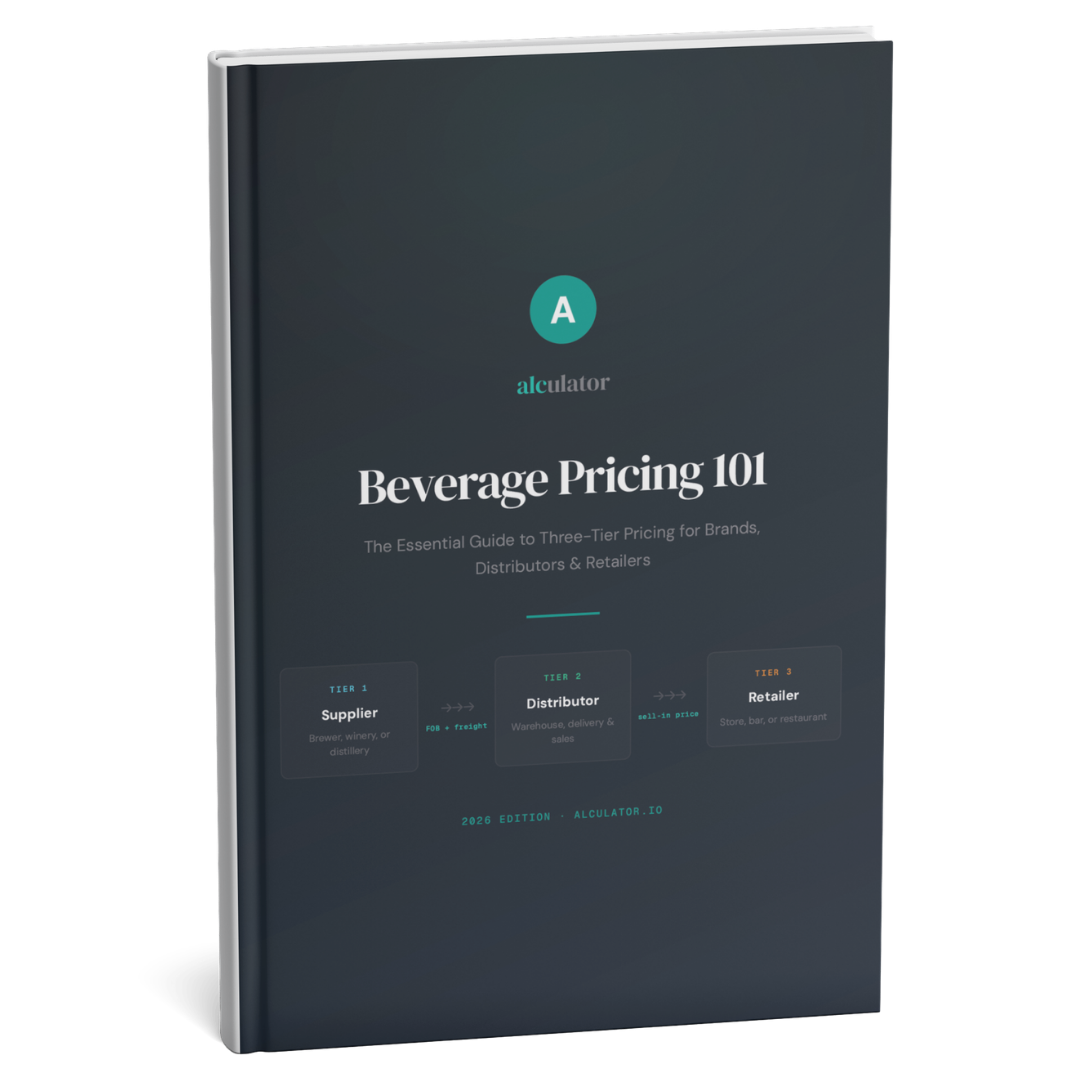
All the formulas and benchmarks from this playbook in a single PDF. Keep it on your desk.
No spam. Unsubscribe anytime.
If you take one thing away from this chapter, let it be this: pricing is not a math problem. It's a strategy problem.
Yes, there is math involved — margins, markups, landed costs, excise taxes, freight rates. We'll cover all of it in the chapters ahead. But the math is the easy part. The hard part is understanding that every number in your pricing model exists in a system with real human beings making economic decisions. Your distributor rep is deciding which brands to push this week. The category manager at a grocery chain is deciding which products deserve shelf space next quarter. The consumer standing in aisle seven is deciding whether to try something new or grab the familiar brand.
Every one of those decisions is influenced by price, and every one of those decisions affects your success. Your pricing strategy needs to satisfy all of them simultaneously: enough margin for you to build a business, enough margin for your distributor to prioritize your product, enough margin for the retailer to keep you on the shelf, and a consumer-facing price that drives trial and repeat purchase.
That's a tall order. But it's entirely achievable when you understand how the system works and price with intention rather than guesswork. Over the next six chapters, we'll walk through every link in the chain:
The three-tier system isn't going anywhere. But the brands that thrive inside it are the ones that understand its economics deeply enough to price with precision. Let's start building that understanding.
Plug in your own FOB, margins, and pack format — the calculator does the rest.
Open the Calculator →