Every conversation in the three-tier chain is about one of three prices. Suppliers quote the PTD (price to distributor, usually the FOB per case). Distributors quote the PTR (price to retailer, the sell-in per case). Retailers set the PTC (price to consumer, the shelf price per pack). The arithmetic between them is short, but because each tier applies its margin to its own selling price, the numbers compound in ways that surprise people the first time. This page walks the whole chain once, with real numbers, so you can check your own.
The Short Answer
PTR = (PTD net of depletion + freight + excise) ÷ (1 − distributor margin). PTC per pack = PTR ÷ packs per case ÷ (1 − retail margin). For a 6×4 case at a $28.00 FOB, 32.5% / 28%: PTR $41.48, PTC $9.60 a 4-pack ($2.40 a can).
Free Download
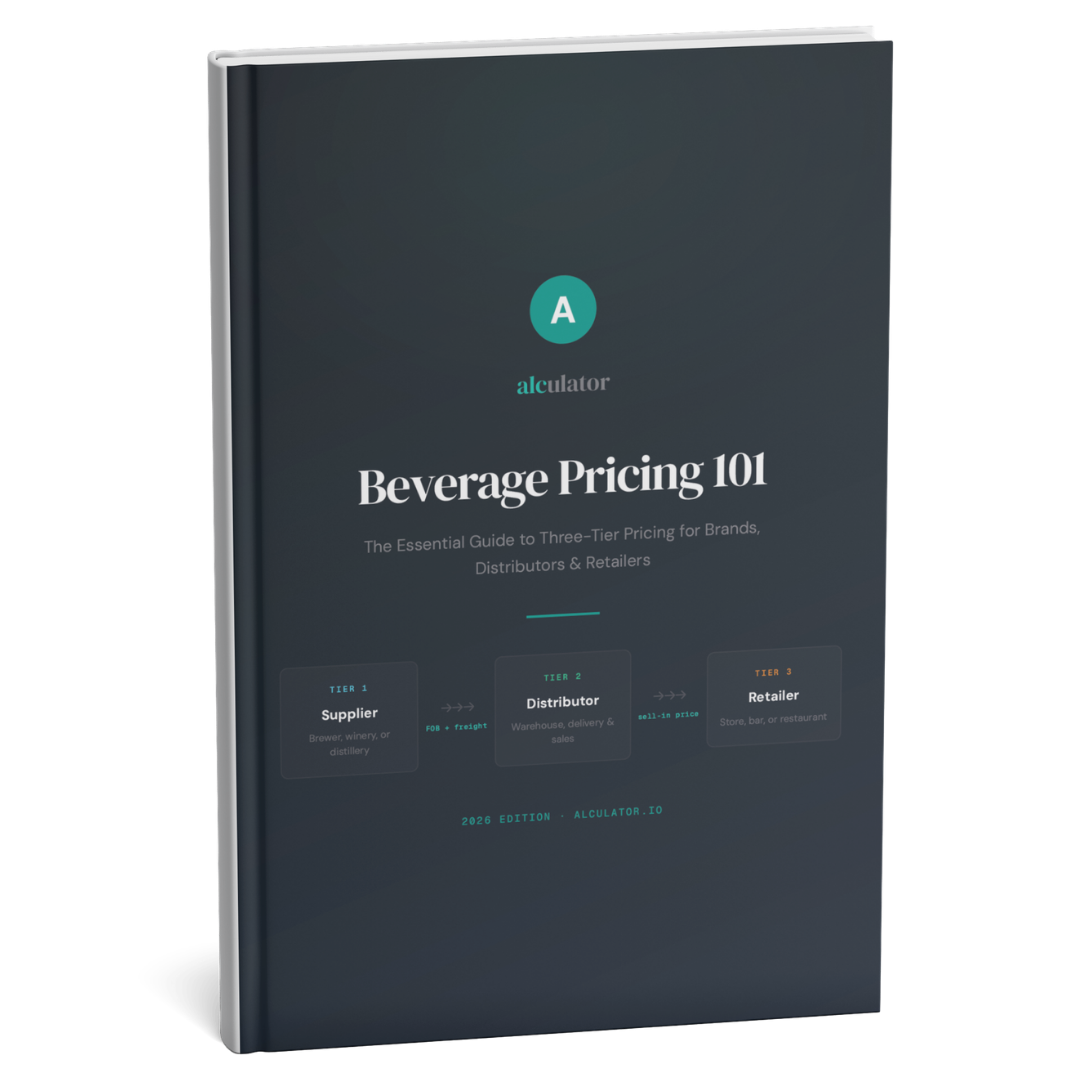
Beverage Pricing 101
The complete guide to three-tier pricing — margins, formulas, and benchmarks in one PDF.
You’ll also join the Alculator email list for occasional pricing tips. Unsubscribe anytime. Privacy
Check your email! Downloading now…
The three prices
The names come from the distributor’s point of view, which is why they confuse suppliers. PTD is what the distributor pays: your FOB, less any depletion allowance you give back, plus the freight and excise the distributor pays to get the case into the warehouse (the laid-in or landed cost). PTR is what the distributor charges the account; the distributor’s margin is the share of the PTR it keeps. PTC is what the shopper pays per pack or per unit; the retailer’s margin is the share of the PTC it keeps. Two things follow. Margin is always a share of the selling price, so each step divides by (1 − margin) rather than multiplying by (1 + margin). And the retailer prices the pack, not the case, so the PTR is divided by packs per case before the retail margin is applied.
Case, forward: FOB to shelf
A 6×4 case of 12 oz cans (six 4-packs, 24 cans), $28.00 FOB, no freight or excise, a 32.5% distributor margin and a 28% off-premise retail margin — the same example used across this site.
Shelf-price rounding is a display convention applied last: $9.60 snaps to $9.49 on a .49/.99 price book. Margins are always computed on the unrounded price.
Case, with freight and excise
Now add $2.50 a case of freight and $0.50 of excise. Both sit under both margins, which is why a $3.00 cost increase becomes more than $3.00 at the shelf.
Three dollars of cost became $1.03 on a 4-pack, or $6.19 per case of retail revenue. The distributor’s GP per case also rose, because its margin percentage is applied to a larger landed cost; that is why distributors rarely object to freight and suppliers should.
Case, reverse: from a $12.99 shelf
The question that actually arrives: “we need it at $12.99 a 4-pack — what can you FOB at?” Run the chain backwards with the same margins, freight and excise.
If your cost structure cannot deliver a $34.88 FOB, the $12.99 shelf is not available to you at these margins; the honest options are a different pack, a different margin conversation, or a different price point. Reverse mode in the calculator flags the case where freight and excise alone exceed what the target leaves, instead of showing a negative FOB.
Keg: per keg and per pour
Draft runs the same chain to the account, then switches units. A half barrel is 15.5 gallons, 1,984 ounces, 124 sixteen-ounce pours at 100% yield. On-premise accounts price against a pour cost (cost as a share of the pour price), so a 25% pour-cost target is a 75% margin on the menu price. Take a $165.00 FOB half barrel, a 30% distributor margin and that 25% pour cost.
Yield is the number nobody writes down: foam, line cleaning and the last pint in the keg push real pours below the theoretical count, so accounts budget 85–90% yield and the true pour cost is higher than the target. The sixth barrel’s higher pour price is the price of flexibility: small-format kegs carry more packaging and handling per ounce, which is why a $75 sixth is not simply a third of a $165 half.
What each tier sees
- The supplier sees the PTD and should know the PTR and PTC it implies, because the distributor’s first question is “what does this land at?” and the retailer’s is “does it fit the set?”
- The distributor sees the landed cost and the PTR, and quotes margin as a share of the PTR. “We need 30 points” means divide by 0.70; 30% markup on cost is 23.1% margin, a different number.
- The retailer sees the PTR per case and prices the pack. A $41.48 case is $6.91 a 4-pack before the retail margin; at 28% that is $9.60, at 35% it is $10.63.
Common mistakes
- Applying margin as markup. Multiplying by 1.30 instead of dividing by 0.70 understates the PTR by $3.60 on a $28.00 case.
- Pricing the case at retail. The retailer prices the pack; forgetting to divide by packs per case produces a shelf price six times too high.
- Leaving freight and excise outside the margins. They are inside the landed cost, so every tier’s margin is applied on top of them.
- Forgetting depletion allowances. Money you give the distributor to fund post-offs comes off the FOB before the chain starts; a margin quoted on the gross FOB is not the margin the distributor sees.
- Quoting theoretical pours. 124 is the ceiling for a half barrel, not the forecast.
Do it with your numbers
Every figure on this page is produced by the pricing engine behind the free calculator and re-checked by our test suite; the formulas are written out on the methodology page. Enter your own SKUs, pack formats and FOBs, set the margins you actually face (category ranges are in the benchmarks), and read your PTR and PTC off the table — or flip a row to reverse mode and start from the shelf. For the single-line version, the distributor margin calculator and the wholesale pricing calculator run the same engine.
Price your own case and keg
Open the calculator, enter your SKUs and margins, and read the PTR and PTC off the table in both directions.
Open the Calculator →